
Modern nursing education is dependent on a structured nursing skills laboratory. It is the place where the students can convert theoretical knowledge into practical clinical competence. The nursing lab equipment to the right allows them the authority to carry out the procedures safely, comprehend human anatomy as a complete system, and acquire the self-confidence to work in actual healthcare settings. Regardless of whether an institute is establishing a new lab or upgrading one, the selection of the appropriate equipment will be central towards making sure that training is quality and that the standards are met.
A nursing lab setup should replicate a simulated clinical setting- full of patient-care equipment, procedure stations, furniture, and simulation apparatus. As more focus moves towards the use of competency-based training, the importance of high-precision simulation training, procedure models and anatomy aids has become more prominent. The following is a breakdown of the necessary equipment that any nursing skills lab requires and how a reliable supplier can be used to help an institution to have a complete and efficient setup.
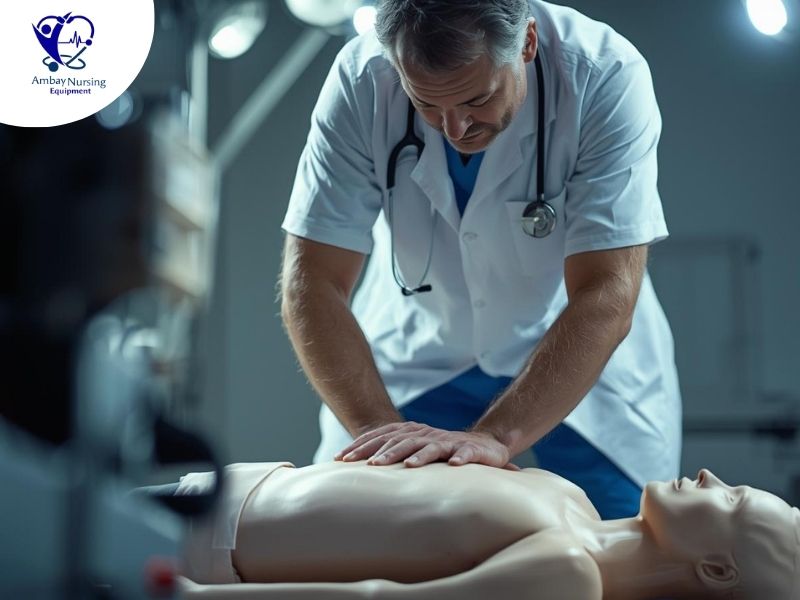
Table of Contents
Reason a Well-Furnished Nursing Lab is Necessary
An entire nursing lab setup assists the students:
- Repeat practice procedures with actual Nursing lab equipment.
- Learn to be accurate in assessing, monitoring and making clinical decisions about patients.
- Learn body systems with anatomy models for nursing.
- Develop teamwork, communication, and emergency response skills.
- Become confident before you have to work with real patients.
Laboratory skill development is now being stressed by the regulatory bodies. This means that provision of standardised materials to labs will make sure that institutions are in check and would improve learning outcomes.
Nursing Manikins and Simulation Trainers
The key to any skills lab is the high-quality nursing manikins. Such tools present to students’ lifelike patient-care situations and assist students in rehearsing a broad variety of clinical tasks safely. Both kinds of manikins help in different fields of learning.
Types of Manikins Required
- Adult manikins on practising general patient care, mobility assistance, hygiene procedures, and vitals assessment.
- Manikins used to train child and newborn care as it involves special skills and sensitivity, pediatric and neonatal manikins.
- IV-arm models, injection pads, catheterization trainers, wound-care simulators and airway management heads are some examples of task trainers.
- Advanced learning high-fidelity nursing simulation manikins applied in high-level simulation such as emergency response, cardiac episodes, trauma scenarios and labour simulations.
Both nursing manikins and nursing simulation manikins are applicable in assisting the students to build confidence, accuracy and clinical judgement. Repeated practice enables them to move with accuracy and confidence and minimizes the chances of making errors in future real healthcare environments.
Emergency Training CPR Manikins
CPR manikin for nursing lab courses is an inseparable item in teaching Basic life support (BLS) and emergency resuscitation methods. Students learn:
- Proper depth and rhythm of giving chest compressions.
- Proper rescue breathing methods.
- Secure trolley in case of an emergency.
- Guidelines on response in cardiac arrest.
These manikins provide immediate response on compression quality and technique which enables the trainees to perfect on their performance. Practice enhances preparedness to deal with life threatening emergencies both in the hospital and in everyday life.
Nursing Education Models in Anatomy
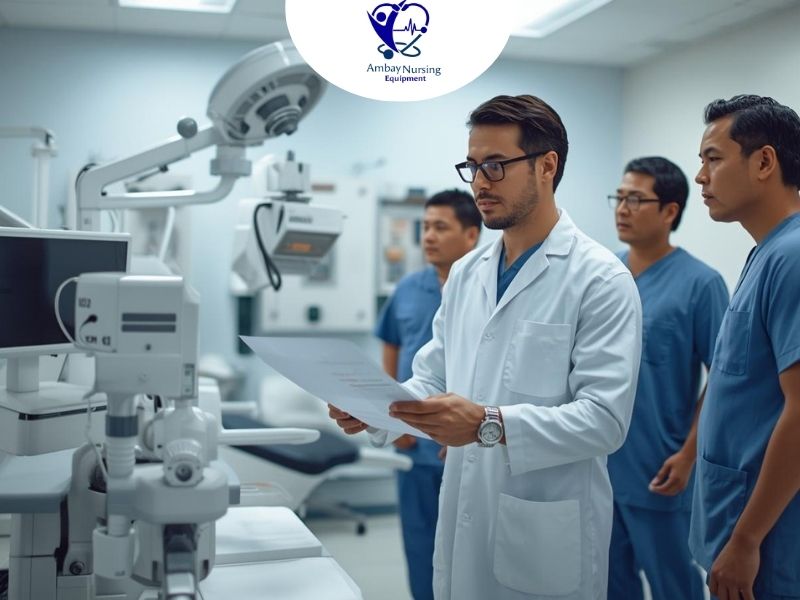
A significant portion of nursing is the knowledge of human physiology and anatomy. Anatomy models for nursing provide practical visual education, which cannot be achieved through textbooks.
Essential Anatomy Models
- Skeletons of the musculoskeletal system, full body.
- Models with internal organs of the torso.
- Heart, lungs, kidney, brain, liver, stomach, reproductive organs models.
- System-based models (nervous system, circulatory system, respiratory system)
- OB-GYN and anatomical pediatric models.
These instructional materials enhance the knowledge of the students about body processes, pathology, and medical practice. They also help in preparation of exams and enhance the capability of retaining information.
Clinical Equipment & Procedure Packages
The full-scale laboratory should have practical medical equipment to assist the students in practising common nursing practices. These materials will introduce the learners to the nursing lab equipment and help them feel more confident practicing their tasks.
Necessary Procedure Equipment
- Stethoscopes, blood pressure devices, thermometers, glucometers and oximeters.
- Injection sets, wound dressing kit, catheterization set, enema equipment and IV infusion set.
- Simulated oxygen masks and respirators, simulated suction machines, and nebulization machines.
- Sterilization-trays, kidney trays, dressing bowls, and clinical gloves.
Through repetition, students will gain expertise in in-patient hygiene care, clinical examination, wound management, administration of medications, and emergency management.
Hospital Furniture and Laboratory Structure
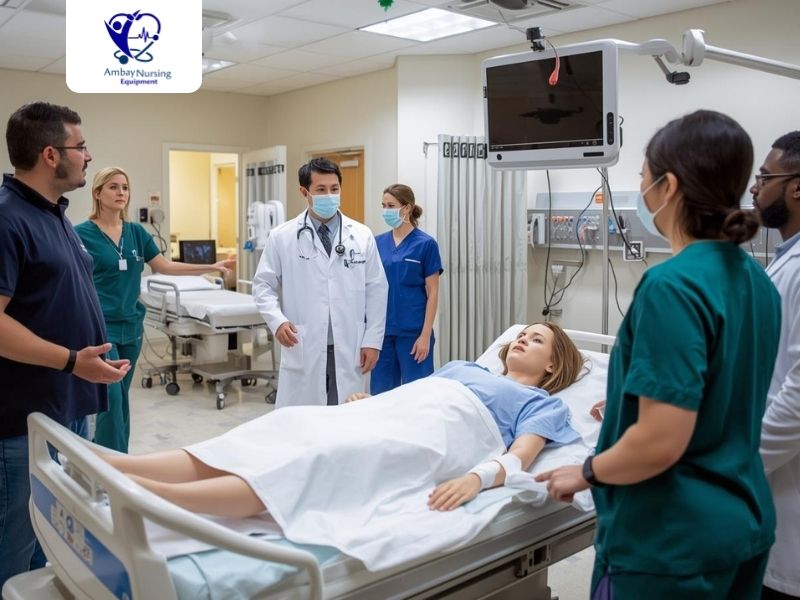
A nursing lab setup must appear and act as a hospital ward. Students also need standard hospital furniture to learn how to help patients, work in a clean environment, and do it effectively.
Key Furniture Requirements
- Manual or semi-electric bed in the hospital.
- Instrument trolleys, over-bed tables and bedside tables.
- The trolleys, crash carts and IV stands dressing.
- Waste collection containers and infection control departments.
- Storage racks, workstations, and cabinets.
A simulated environment assists students to become acclimatized fast during clinical postings and internships.
How the Ambay Nursing Equipment Helps Institutions
To achieve a lasting and standards compliant lab, it is important to select an appropriate supplier. Ambay Nursing Equipment provides high quality curriculum-oriented equipment to address the academic needs of nursing colleges and training centres.
Ambay Nursing Equipment Comprehensive Lab Solutions
They offer a complete assortment of nursing lab equipment: simple manikins and anatomy models as well as complex simulation devices and procedure packages. The institutions enjoy the benefit of good equipment that not only improve the quality of learning but are also durable to the frequent use by students.
Ambay Nursing Equipment End-to-End Guidance
They assist colleges to select an appropriate set of tools, create the layout of labs and create an entire nursing lab setup environment, so that it is fully efficient and meets training standards.
The Reason Colleges like Ambay Nursing Equipment
Their equipment is the most popular among institutes that wish to better their practice-based learning and enhance student performance due to its durability, precision, and adherence to the curriculum.
Several studies highlight that technology-enhanced learning tools in nursing education lead to better knowledge retention and decision-making, as reported by ScienceDirect.
FAQs
Q1. Why are manikins necessary in a nursing skills laboratory?
They enable students to work out the procedures in a safe environment, train their muscles and become more confident when nursing manikins are confronted with actual patients.
Q2. Do anatomy models substitute clinical experience?
No, but anatomy models for nursing strongly enhance anatomical knowledge and support the theoretical study.
Q3. Which furniture is needed in a nursing laboratory?
Beds, trolleys, IV stands, storage units and bedside lockers are utilized to recreate the real hospital atmosphere.
Q4. Is a CPR manikin mandatory?
Yes. CPR manikin for nursing lab is mandatory in practicing life-saving skills and meeting the requirements of the curriculum.
Q5. What should be the frequency of Nursing lab equipment upgrades?
It needs to be revised after 2-3 years or when there is a change in curriculum guidelines.