
Practical experience is indispensable in the development of competency in the current healthcare education environment. Be it creating a nursing lab equipment inventory or you are updating your curriculum by adding advanced training tools, a question always comes up, should we be using a CPR manikin or training partner to teach cardiopulmonary resuscitation (CPR)?
Each of these approaches has its benefits and drawbacks, and the correct selection depends on your goals of education, the resources of your program, as well as the outcomes of your learning. This paper will analyze the differences between the use of a CPR training manikin and a training partner to inform educators, instructors, and institutions to make informed choices.
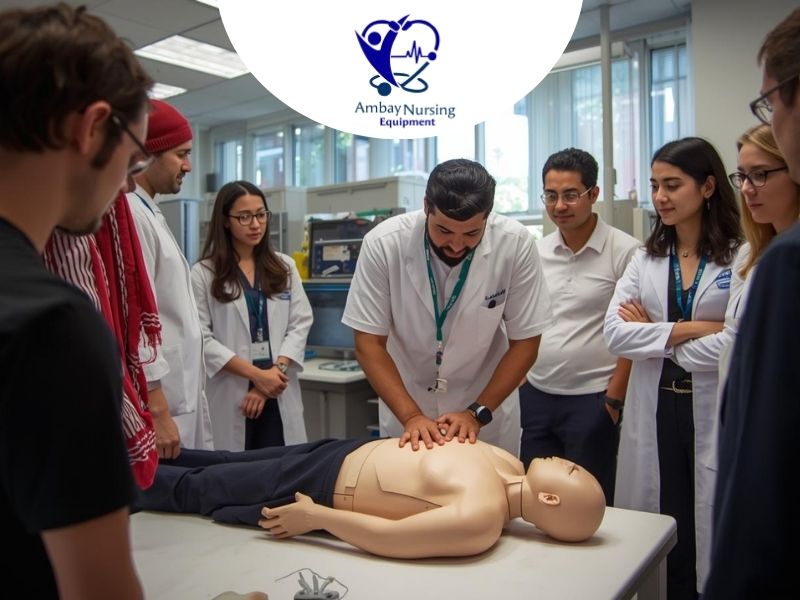
Table of Contents
The Role of Practical Training in Nursing Education
Professional healthcare education is highly based on practical skill development. Before students can work with real patients, they have to learn to apply the theoretical knowledge in practice in controlled conditions. The change is also enabled through the use of high-quality nursing lab equipment that includes simulators, anatomical models, and resuscitation tools to replicate real-life conditions.
CPR is one of the most important processes that nursing students should learn; it is a life-saving intervention that requires skills, confidence, and muscle memory. The discussion about the use of physical training aids or live practice partners is about the most effective way to integrate long-term competency in students.
Why are CPR Manikins the necessary training tools?
CPR manikins are specifically tailored models, which are used to simulate human anatomy in the procedure of resuscitation. They are in different variations, such as simple static torsos up to the advanced with feedback technology that improves learning results.
Development of Objective Skills
Manikins also offer uniform resistance and response compared to practising with a partner; the student of a manikin experiences the same type of responses at the same time as the student using an actual partner. Even the advanced models are measured by the compression depth and position of the hand, which assists students in correcting them and perfecting their skills.
Security and Comfort of Learners
To the novice, it may be daunting and physically challenging to administer CPR to a live individual including a colleague. Manikins neutralize the social awkwardness and safety issues that might be in place when one has to administer chest compressions to another individual and learners are then able to concentrate on the technique fully.
Repeatability and Durability
It is common in training situations where a learner needs to repeat several times before mastering the training situation. A CPR practice manikin is designed to support the repetitive use, which allows the student to practice as much as necessary without a threat of harming a classmate.
Realism Which Increases Confidence
The contemporary manikins imitate the finer aspects of human responses e.g. chest recoil after compression. These practical components assist in filling in that gap between learning in a classroom and the actual patient treatment.

Low Cost and Easy Setup
A training partner is virtually free compared to other devices such as technical devices which might need service or extra accessories. This especially attracts small institutions or programs with small budgets.
Key Differences Between Using a Manikin and a Training Partner
The proper training is based on the compatibility between training and learning objectives. CPR manikin enables students to train compressions and ventilation with the same consistent resistance and safe repetition, which is best to develop proper technique during their early learning stages. Monitoring of performance is also supported by some models, as they assist the instructors evaluate the accuracy of the skills.
Training the partner proposes the variation of humans and facilitates teamwork, communication, and awareness of the role in an emergency situation. Although this makes this method more realistic, closely supervising it is necessary, since feedback is mainly observational.
To fully develop skills, most institutions have integrated the two approaches in their nursing lab equipment facilities to achieve a balance between technical and practical readiness.
What Could Be the Best Alternative in Your Nursing Curriculum?
The simple solution: neither of the methods can be applied independently. An integrated method provides the strongest learning process.
Initial Skill Acquisition
Begin with CPR training manikin which will create the right position of hands, depth of compression, and rhythm. The feedback and consistency assist the learners to develop confidence at the early stages.
Team and Peer Practice
After the learners have developed the basic competences, incorporate the training associates to learn how to work in a team, communicate, and handle human variability safely and under supervision.
Advanced Assessment
Assess competency using manikins with feedback performance systems and then move on to real life simulation or clinical rotations.
A combination of these two methods would make sure that students are not only technically ready but also socially and emotionally ready for real emergencies.
A Word on Cost: Learning CPR Manikin Pricing
The CPR manikin price may vary widely depending on functionality – simple non-moving models that are practical to start with, to high-end ones with sound and audio-visual response to monitor performance.
Organizations need to consider their long-term training requirements and investment versus sustainability, education benefits and curriculum fit. When it comes to nursing lab equipment the appropriate combination of models will guarantee achievement of learning objectives without any waste.
Ambay Nursing Equipments provides a selective choice of quality CPR dummy for training, as it will enable easier provision of nursing schools with labs that will meet the accreditation standards and equip students with the skills to succeed in clinical settings.
Real Educator Insights
Experienced nursing teachers stress that the practice grounded in practice in the classroom is most effective when students get both the technical and interpersonal experience. Teachers also observe that students who have realistic manikin sessions show initial improvement and acquire more skills, which are maintained when they work with human partners, especially when supported by quality training solutions from Ambay Nursing Equipments.
Conclusion
Considering CPR training equipment as part of your nursing lab equipment installation, it is apparent that both CPR manikins and training partners are both important:
- Manikins offer standardized risk-free situations in which correct technique can be developed.
- Training Partners bring real life dynamics which enhance flexibility and collaboration.
The combination of the two approaches into a systematic curriculum is optimal to maximize learning outcomes, develop confidence, and provide students with the necessary skills needed to work in vital care conditions.
You might be buying your first CPR practice manikin, or you might be planning a whole clinical skills lab: either way, the right tools and the right training structure will make sure that your students are equipped well to spend their lifetime saving lives.
To have both balanced training laboratories and facilitate objective examination and effective interaction, select reputed suppliers such as Ambay Nursing Equipments, which provide sustainable and workable options to contemporary nursing training.
FAQs
Q1. Should nursing skills labs use a CPR manikin?
Yes, manikins enable students to repeat compressions and ventilations as many times as they wish without harming themselves and developing muscle memory and confidence.
Q2. Are manikins substitutable with training partners?
Peer learning is important when using training partners, but the standardization and feedback cannot be provided by any other methods as by manikins.
Q3. Can you select the correct CPR manikin price range?
Reflect on your curriculum objectives: simple models of torso are used to follow simple skills, and complex units with feedback mechanisms are used to test and train on high skills.
Q4. Is it better to mix men and women manikins in training?
Diversity in models would assist learners to comprehend variability of humans and enhance real-life preparedness.